


I’m very grateful for the creative period we live in now. A period where Black stories are being told from different points of views–where they can be heroes instead of the villains hiding in the shadows. A period that allows me to step into a dark theater and see films like If Beale Street Could Talk(2018), Sorry to Bother You (2018), BlacKkKlansman (2018), and The Hate U Give (2018) without feeling wholly alienated and ostracized because on that giant screen was my people. And those people were telling stories that have deserved to be told for decades. Despite this incredible progress, it did take Black directors and actors a long time to get here. And during that time, I had to find role models in characters that didn’t look like me.
There weren’t many movies that depicted what it was like growing up as a Black teenager in America, or even really discussed what Black teens go through in America, so I had to find solace in teen movies that depicted the stories of white characters. Sure, none of these people looked like me, but little naïve me thought that our stories of growing up had to be fundamentally the same. What was the harm? Now that I’m a little older I have realized that it’s hard to understand your own story better when you’re too busy being a side character in someone else’s.

Bring It On, a cheerleading movie that came out in 2002, was one of the first movies I saw that showed both sides of the coin. It detailed the lives of a white person, as well as a Black person. It also did it in a way that wasn’t what we typically see in media today or have seen in the past. The portrayal of the Black characters wasn’t degrading (though, possibly mildly stereotypical) nor were they written into the archetypes that we’ve so often seen. Bring It On shaped me in ways that still resonate with me today.
Gabrielle Union (ugh, love her) has been in several iconic teen movies (those you may or may not have seen), such as 10 Things I Hate About You(1999) and She’s All That (1999). But, for most of them, she is shamefully typecast into roles where she isn’t given much development. Most of her time spent on screen is serving her best friends (who are white) and trying to remain the voice of reason (a stereotype that is typical for those who fall under the BBFcategory). Her characters are hardly what one would consider to be “role models.”

However, Bring It On marked a new age of teen movies because half the cast is Black (something unheard of at that time).Representation at the time this movie came out seemed to be few and far between. Hollywood is often challenged and criticized (as it should be) for its hiring practices that create stories that only the majority can fully relate to. By hiring just white actors to play leading roles, it feeds power into a system that systematically places Blacks and other minorities at the bottom. It distributes power to a system that demands our stories not be told. Because of this, being white has immense power in our society, as well as in our films:
“In the realm of categories, black is always marked as a colour (as the term “coloured” egregiously acknowledges), and is always particularizing; whereas white is not anything really, not an identity, not a particularizing quality, because it is everything…White people “colonize the definition of normal.”
– Richard Dryer, “White: Essays on Race and Culture”
Bring It On was one of the first movies I had seen during my tween years that showed the start of increasing representation of people of color in film. In the film, the head cheerleader, Torrance (played by Kirsten Dunst), has learned that her previous captain has been stealing and performing routines from another high school squad that is comprised of minority students. (Union is the captain of this team). When Torrance learns this, she tries to put a stop to this, but of course, competition ensues. Union’s character, Isis, was such a dominating figure in the movie, and not because she was being portrayed as the angry, Black woman that has taken over our screens even today. She was just upset—and she had a right to be. This was the first character that I saw myself in—the first Black character I had seen on screen that I could genuinly relate to.
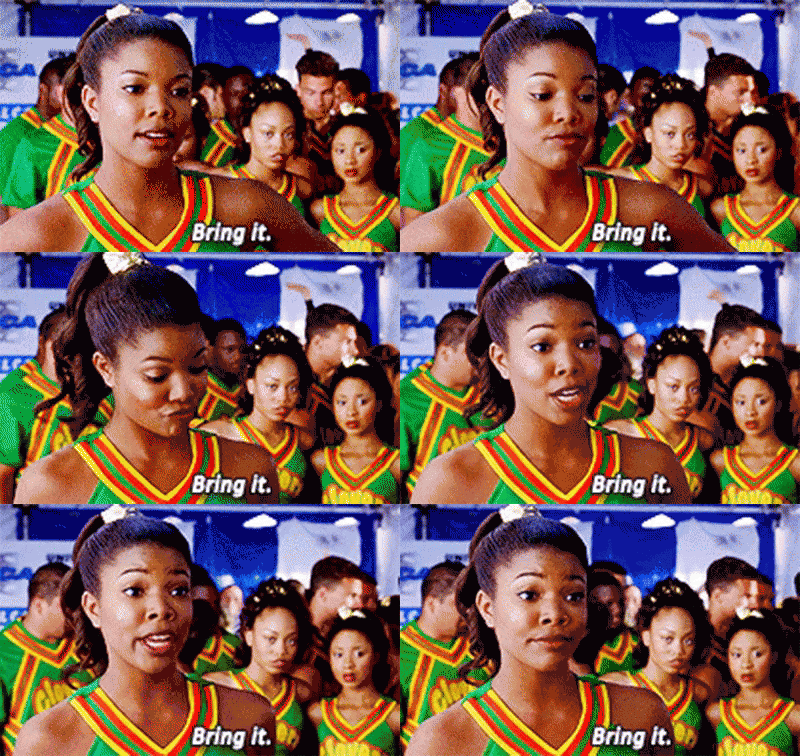
While some may think the plot of Bring It On is particularly corny and a bit dated, the movie had no shortage of lessons that I, a young Padawan, was eager to learn about. This movie depicted so many things that I was aware of in daily life but could never put a name to (ex. microaggressions, cultural appropriation, stereotyping). Here are a few of them:
1. Black Characters Can Be Portrayed as “Antagonists” Without Being the Actual Villains
The standard definition of an “antagonist” is just any character that is opposing the protagonist/main character. It does not necessarily have to mean that they are malicious or actively finding new ways to hurt the protagonist. Union’s character showed me this. Sometimes when you have to fight back you have to use claws but in a classy way. Too often do we see Blacks placed in villainous roles (not that I have anything against villains) that have no substance. Sure, they’re angry—but about what? What are they truly fighting for? In Bring It On, Isis’ squad is fighting for the recognition they deserve.
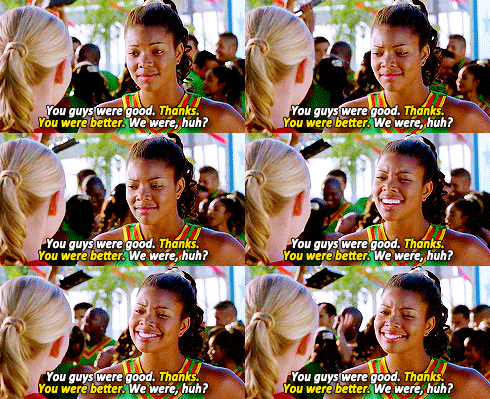
This movie intended to show that this exaggerated feeling of anger that is so often associated with Black women comes with the territory if fighting for equality. However, Union was never portrayed as a violent or unreasonable person. She was straightforward and to the point, but she was never aggressive or vindictive. It was pretty refreshing for me to watch a movie where the Black characters weren’t blamed or criticized. We’re supposed to want to root for them.
2. IF YOUR FEMINISM AIN’T INTERSECTIONAL THEN I DON’T WANT IT
Both of these women (both Union and Dunst’s characters) are powerful women in their own way. In Torrance’s case, it not only takes a lot of guts to be the first to admit you’re wrong but to also correct those mistakes. For Isis, she realized that there was strength in being vulnerable. She knew that her squad needed money to compete, but rather than take money they didn’t earn, they asked for help from their community.
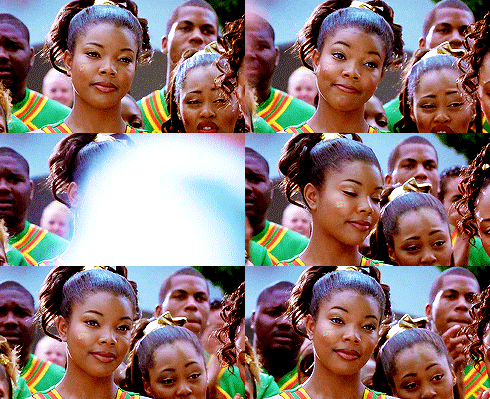
This movie portrayed women of different classes and races and managed to piece together their stories in a cohesive way. Union never apologizes or pretends to be modest. She doesn’t let the team see her and her squad as the underdogs just because they come from a different class system. Intersectional feminism is critical because not every feminist is female, white, or middle class. It acknowledges the many different backgrounds that we all come from.
“The view that people experience oppression in varying configurations and in varying degrees of intensity. Cultural patterns of oppression are not only interrelated, but are bound together and influenced by the intersectional systems of society. Examples of this include race, gender, class, ability, and ethnicity.”
–Kimberlé Crenshaw
Feminism is not one-size-fits-all.
3. Oh, That’s What That’s Called
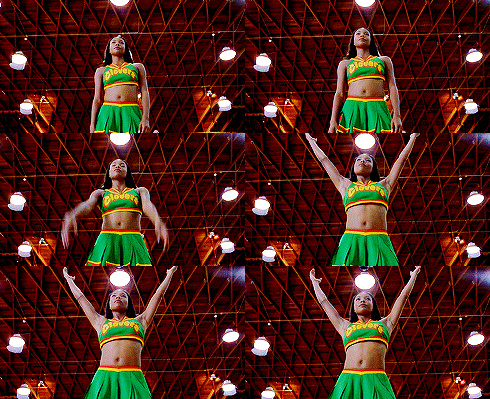
Thinking back on it, I guess my real true experience with cultural appropriation was with this film. It was almost like a crash course on cultural appropriation, but sneaky-like in a way that totally made sense to ten-year-old me. There aren’t many films that show white teens stealing from Blacks and managing to not get away with it. In this movie, Torrance’s squad stole from a Black squad and then tried to make the routine more palatable to the tastes of their own student body. It was smart for the writers to utilize this in the film because it just heightens the fact that appropriation, whether it comes from a place of appreciation or otherwise, can lead to the erasure of that culture.
I know that many people before me have said it, but I will continue to say it because it demands to be heard: representation is important. Minorities need to know that they have the capabilities to be superheroes, to be lawyers, doctors, to be artists, to be kind, to be loved and love in return. They need to know that there are people out there like them who have the same stories and who get it. Sure, we can get enjoyment and entertainment from watching movies without representation, but it’s hard to fully connect with a film where none of the characters look like you. While Bring It Onmay be just another teen movie to many, it was the first movie I ever watched that made me hopeful for the person I was going to become later in life.
 BLACK-PLOITATION